
When you hear the name “Aphrodite” what first appears in your head? Is it a tall, slim, white woman with hair reaching her knees? Or do you think of “Aphrodite’s Fountain”, the mythical spring from 2008’s Mamma Mia (which famously erupts during the Wedding Reception and final musical number)? Under her Roman name “Venus”, you might perhaps first think of the planet second from the sun in our solar system? As one of the closer planets we can sometimes spot it at night if the stars align, and Venus has been known by humanity worldwide since the dawn of civilisation. Less prestigiously, the name “Venus” day-to-day might invoke advertisements for the razor blade brand, accompanied by Bananarama’s 1986 cover of “Venus”, originally by Dutch band Shocking Blue.

In both high and low culture, Aphrodite is still present very much today. We see her as symbolic of womanhood and the female physical ideal, but Aphrodite as she was worshipped thousands of years ago was more than just that. She was not only the goddess of love (both romantic and physical), but also of the sea, invoked by seafarers for protection. Her protective powers trace back to her origins in Cyprus, where in her earliest form she was an all-powerful mother goddess figure. Her connections to love naturally branch to fertility, and of course marriage – making her a fitting subject for our journal!
With the opening of Aphrodite: The Making of a Goddess major exhibition at our neighbours the Ashmolean Museum, the Bodleian Weddings Team decided to visit and discover everything we might just not know about this fascinating goddess.

Let us start at the beginning, or as early as we can. On the island of Cyprus, a single, all-powerful deity was worshipped from about 1200 BCE onwards. Over 100 sanctuaries have been discovered on the island which were dedicated to the goddess “Kypris”, this name rather bluntly translates to “Cypriot goddess”. She was invoked for protection in all forms, some depictions of Kypris show her with a crown in the shape of a city wall around her head – clearly protecting the local people. Handheld figurines of Kypris were made and kept, to protect women during pregnancy and childbirth. Sailors and merchants would ask for protection as they sailed away from Cyprus to trade, and in turn other merchants would bring their own mother-goddesses or protective goddesses with them. Many features of other goddesses, such as from Egypt and other parts of the Middle East would merge into Kypris.

Eventually around 1000 BCE, this popular Cypriot goddess was also adopted by Greeks in the mainland and surrounding islands. The Greeks already had a huge host of gods, and she became a part of that (quite often disruptive!) family. To distinguish her from the goddesses, she was given the name Aphrodite, which starts to be used by 800 BCE. Once she had been adopted into the larger Ancient Greek religion, this is when her focus of worship shifted to love and all its aspects, like beauty and of course marriage. Again, this was to distinguish her from other goddesses which were already worshipped.

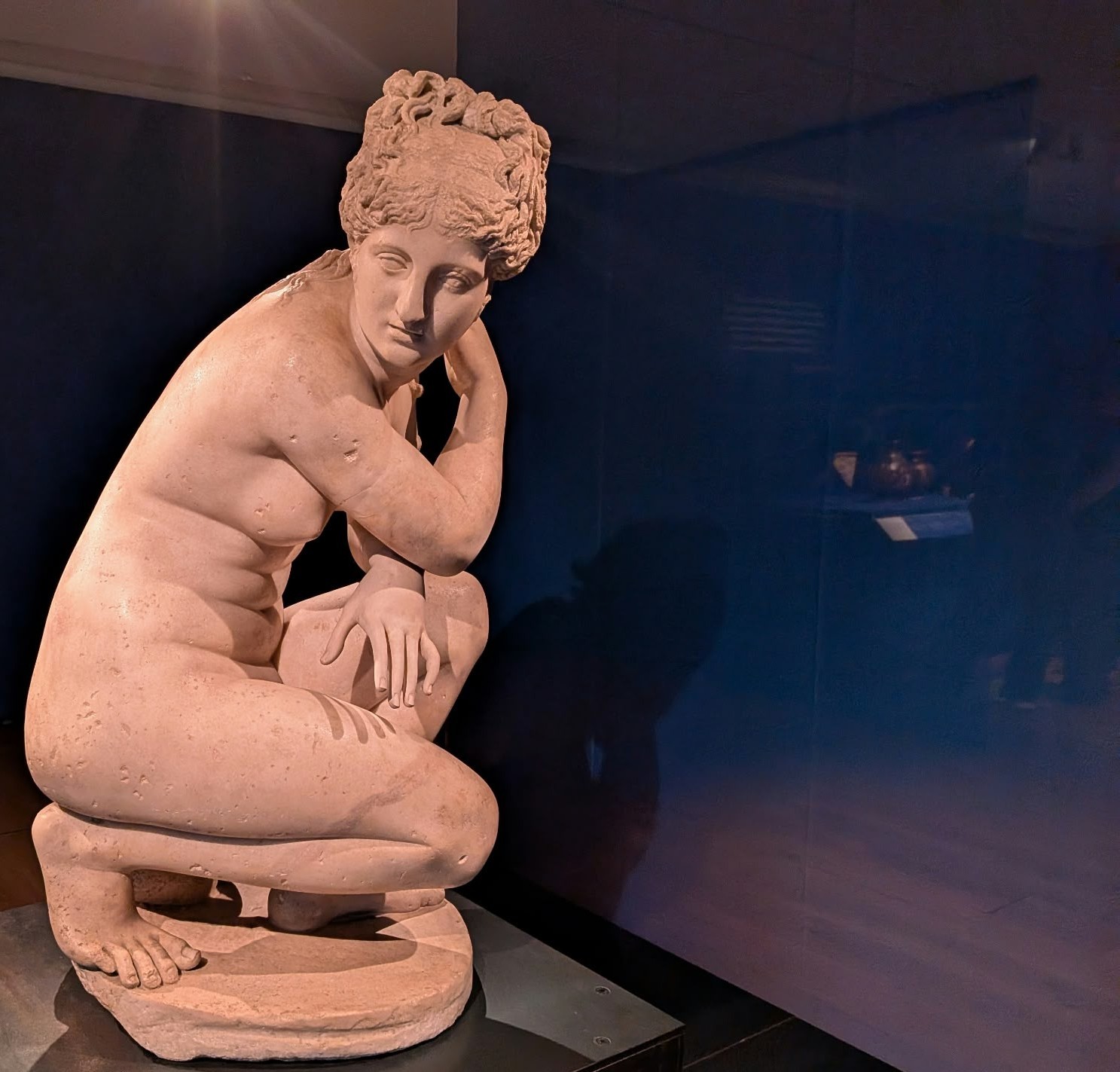
Her connections to Cyprus and the sea however are still apparent in her mythological origins. She had emerged from the waves of the Mediterranean, and many images of her show her riding animals such as dolphins or even arriving via a shell, onto the shores of Cyprus. Like many of us after a big journey, she went to bathe. As her first act on dry land, many artisans have depicted Aphrodite crouched naked bathing. Once completely clean, she adorned herself with perfume, jewellery, and beautiful clothes, cementing her identity as the goddess of beauty. Her beauty was so outstanding, that Zeus, king of all the Gods, arranged a marriage for her almost immediately to end quarrelling. Aphrodite was married to Hephaestus, the god of fire, craftwork, and ironmongering. Sadly, it was not a happy match.

Despite her marriage, Aphrodite was often coupled with (out of wedlock!) Ares, the God of War. You might also recognise Ares with his Roman name – “Mars”. This union of two opposing forces, one of love and one of war, seems to be one of the first examples of “opposites attract” in popular culture. Of course, the one God who was not happy about this situation was Aphrodite’s actual husband, Hephaestus. After learning of their relationship, Hephaestus devised a plan of capturing the two in flagrante together in bed.

Setting a trap in the bed with a finely made net, it sprung and captured both Aphrodite and Ares together. Hephaestus then called in all the other gods, so they could witness the adulterous pair. Almost all of the gods fell about laughing at the two bound in the net, except Zeus. As the matchmaker for Aphrodite, he was furious at her for breaking her vows. For her punishment, he declared that from this point on she could only fall in love with mere mortals. A bit of a strange punishment, and as we will discover, she really didn’t seem to mind this.

Aphrodite was famously linked with Adonis, a mortal man who was an avid hunter and exceptionally beautiful. Even to this day, you sometimes see the word “Adonis” used to describe an attractive man. Sadly, their tale ends in tragedy when Adonis was killed by a wild boar on a hunting trip. Another lover was the Trojan prince Anchises, with whom she had a son – Aeneas. Aeneas was a hero of the Trojan war, and when Troy fell he departed on a ship with survivors to look for a new place to settle. According to legends, he landed in Italy and was the ancestor of the founders of Rome – Romulus and Remus.

With all these relationship ups and downs, it might be surprising that not only was Aphrodite the goddess of marriage, but also the goddess of happy marriages. Maybe the Ancient Greeks understood that the courses of true love never run smooth? Or maybe that every relationship encounters its hiccups and difficulties? Or perhaps that some truly loving relationships have a tragic end? But one part of Aphrodite’s tale links her very closely to the fabric of Ancient Greek wedding ceremonies, which is her famous bath we mentioned earlier in the article.

On an Ancient Greek bride’s wedding day, she would be given a bath in the morning. This bath symbolised purification as well as fertility. Many depictions of Aphrodite in wedding scenes show her assisting with the bath or watching over the ceremony taking place. Again, her origins as a protector are coming back into play! Eventually, the Ancient Greek civilisation would be swallowed up by the Roman Empire. The Romans, with their love of all things Greek and of course Aphrodite (remember her descendants founded Rome itself!), saw her veneration spread across their huge Europe-wide empire. This includes us in Britain.

Just like her origins in Cyprus, when Aphrodite travelled across the Roman Empire, she merged with local gods and art styles unique to that area. In the Ashmolean exhibition, there are two objects with a unique Romano-British interpretation. Firstly, we have the wonderful sandstone carving, showing Aphrodite at her famous bath! Whilst she appears a bit blunter than in Greek or Roman depictions, she is unmistakably wringing out her long hair and an attendant is passing a jug to her. Could this be her perfumed oil, ready to apply after drying off?

The second is this fabulous little copper figure, discovered only four miles away from Oxford. She is clothed in the style of a local Romano-British goddess, but her hairstyle is similar to what high-ranking Roman women wore during this time. Even though we are a cold, rainy island, thousands of miles away from sunny Rome or Cyprus, Aphrodite still struck a chord with the people and made her impact. The need and desire for love in all forms is something which is fundamental to the human experience, and no doubt that is why she remained popular so far from home.

As the Roman Empire became increasingly Christianised, the worship of gods like Aphrodite began to fade away. It was just over a thousand years later, when Italian Renaissance artists in the 1400s began to rediscover the ancient past, that she entered popular culture again. Artists and historians began to discover, repair, redisplay, and in a lot of cases replicate, sculptures from the Ancient World. As a prominent goddess, Aphrodite was no exception to this. But rather than being venerated as a goddess again, she became the ideal depiction of feminine beauty. It was only several centuries later, during the 1900s that artists began to challenge this assumption.

All of us on the Bodleian Weddings Team hope you have enjoyed this journal article, as it is a little different to what we usually post. If you enjoyed this little dash into history, then do have a read about our Hidden Historical Couples at the Bodleian Libraries. Or with the festive season coming up quickly, why not explore Christmas Weddings at the Bodleian? Take care and we hope to see you next time!
The exhibition Aphrodite: The Making of a Goddess is now open until 11th April 2027, at The John Sainsbury Exhibition Galleries, Ashmolean Museum, Beaumont Street, OX1 2PH.
Leave a Reply