
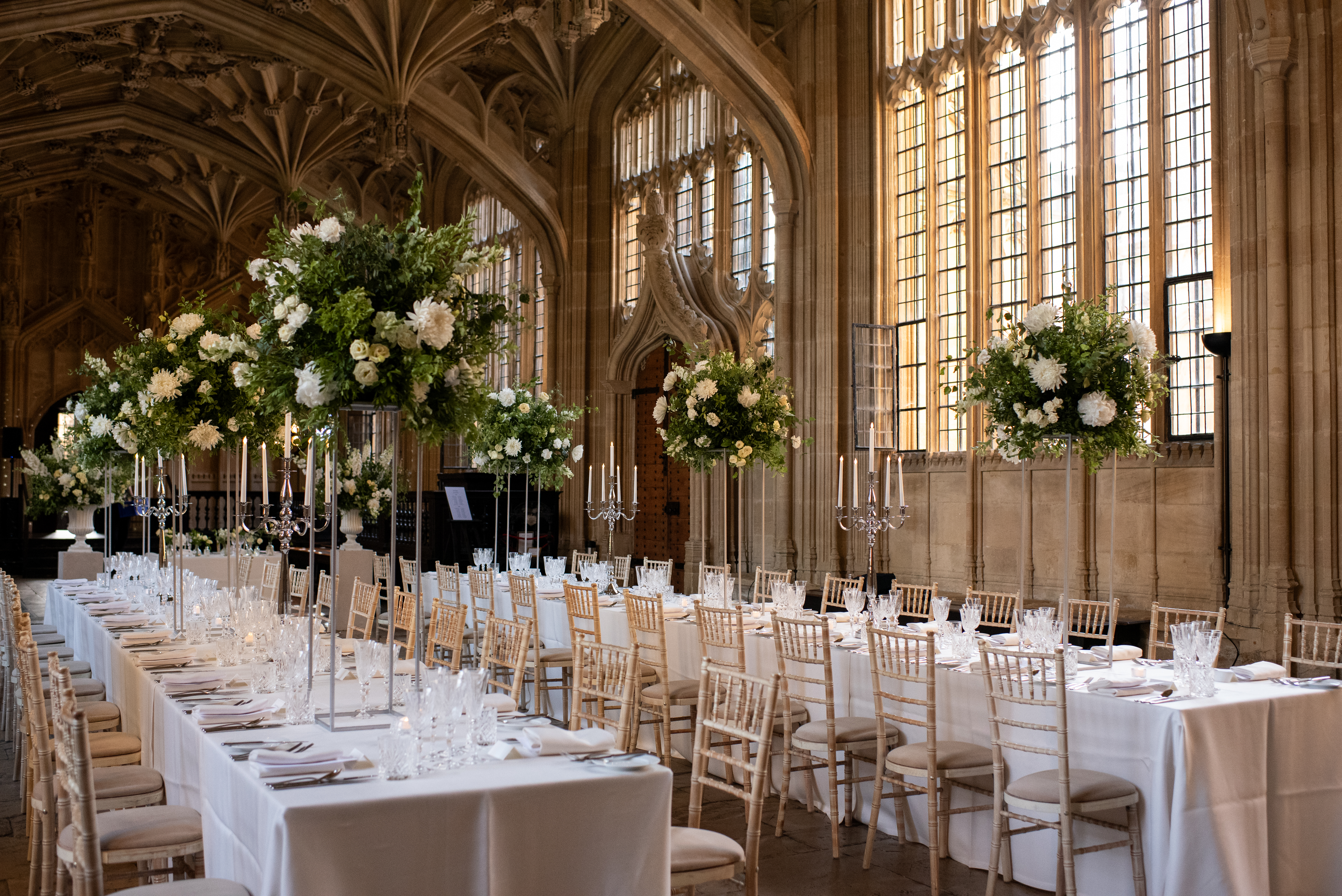
It should not surprise anyone that plenty of historical figures that have walked through the doors of the Bodleian. The oldest part of the building, the Divinity School, has been standing since the 1400s. At about 600 years shy, thousands, if not hundreds of thousands of Oxford alumni and other notables have passed through in those six centuries.
Although we mostly discuss all about weddings for our journal articles, we’ve decided to dedicate this month’s journal entry to exploring some of the significant figures to the connected to the Bodleian Libraries. So do get comfy as we take you back in time!

Divinity School
The first room we will visit is the Divinity School. Today, not only is this space visited by many tourists from all over the world, and used in plenty of film & TV productions, but it’s also used for weddings as well. If you opt for a Reception with us, the Divinity School is where not only the wedding breakfast takes place, but where your evening party commences too! Or if you would rather spend just your ceremony with us, we can seat up to 150 guests amongst its golden-coloured stone walls.

Built in the 1400s, the Divinity School is the oldest part of the Bodleian. The word “Divinity” meant Theology in England during this time, and this was designated to be the classroom and exam space for Theology at the University of Oxford. Hence, its name “Divinity School”. This is why the room looks as though it could be an old church, it is packed full of religious symbolism and iconography. But for now, we are going to focus on our fantastic ceiling.

The carvings on the ceiling are formerly called “bosses” and there are easily over 400 of these on the ceiling. Many of these bosses represent people who donated money towards the Divinity School to aid in its completion. The largest boss, right in the middle of the ceiling belongs to King Edward IV (1442 – 1483). King Edward was a lucky man. He wasn’t born a prince, but ousted the previous King off his throne, and crowned himself King. Edward was also a bit of a romantic too, as he married his non-royal(!) wife in secret. Her name was Elizabeth Woodville, and due to her non-royal heritage, it caused a scandal in England at the time.

Why we’ve mentioned this very royal scandal is because one of Elizabeth’s brothers is also commemorated on a boss on the ceiling. His name was Lionel Woodville, and he was also Chancellor of the University from 1479 – 1483. Whilst Lionel is commemorated due to his direct connection to the University, it’s a unique situation where two brothers-in-law featured in the same place. How appropriate that these family ties exist in a venue where two families come together to unite under love.

We also have two pieces of furniture in the room, which somehow go unnoticed, but still have interesting connections. The first is what is known as the “Drake Chair” and this is next to the Wren Door, where your guests would enter on your wedding day. The reason for this name is because the wood used to make this chair originally came from Sir Francis Drake’s ship Golden Hind which he used to circumnavigate the world in between 1577 – 1580. After the ships return (and it was also laden with plunder from Spanish treasure ships) Queen Elizabeth stepped on board the ship and declared it to be on permanent display.

This also makes it the first documented “Museum ship”, a bit like today’s HMS Belfast or the Cutty Sark. However, by 1668 after decades of being kept in the dockyard at Deptford the wood had almost rotted away. The keeper of the stores at Deptford had an ingenious upcycling idea. He used the best quality wood he could find on the ship and made it into a chair to be presented to the Bodleian Library. It is also kind of ironic that such an iconic ship is now kept in one of the furthest places in the country from the coast!

Another piece of interesting furniture in the Divinity School is on the other side of the room, and this one is a bit more directly connected with this Bodleian. The huge (and heavy) iron chest you see belonged to Thomas Bodley, who is the namesake of the Bodleian Libraries! We’ll discuss Thomas Bodley in more detail later, but we’ll focus on the iron chest for now. In ages go by, when it was very difficult to reach a bank to deposit your money, many people kept all their wealth in iron chests like these.

Of course, the incredible weight of these chests meant that it was very unlikely anyone could run off with all your money. In his will, Thomas Bodley donated his “blacke iron chest” as he called it to the Bodleian Library. Today it is now used as a donation box by the Friends of the Bodleian, a membership to help preserve our beautiful building and unique collections.
Duke Humfrey’s Library
Directly above the Divinity School sits the Duke Humfrey’s Library, and like the Divinity School it was first built in the 1400s. Today, the Duke Humfrey’s Library one of the most popular and beautiful study spaces for scholars. As you can imagine, this space is also frequently requested for film and TV programmes as well. For the weddings team, it’s the site of many of our private couples photography sessions, as well as intimate elopement ceremonies.

But who was Duke Humfrey, and why is this Library named after him? Duke Humfrey of Gloucester (for his full title) was the fourth son of King Henry IV of England. As he was the “spare” times three, Duke Humfrey spent a lot of his time dedicated to scholarly pursuits. He collected manuscripts mainly from Italy, where the Renaissance was just beginning to take place. It seems Duke Humfrey was quite a generous man, as he donated his collection of about 300 of these manuscripts to the University of Oxford.

The University of course accepted such a grand gift, but there was nowhere to store it! The Divinity School was being built at the exact same time, so it was decided – why not just build the new Library on top? If you store your manuscripts nice and high, it keeps them away from damp and pests, so a very smart choice to make. Duke Humfrey also had a very interesting relationship with Eleanor Cobham, who was his mistress and eventual second wife. The two of them shared a bond in intellectual pursuits, which no doubt brought them together. In one of our previous posts we’ve written about both Humfrey & Eleanor, and other Bodleian couples, so do have a read.

Sadly, Duke Humfrey’s fantastic gift fell into despair. Almost all of the manuscripts had been stolen or destroyed, so the University sold all the original furniture that was in the Library. In steps a man called Thomas Bodley. Whilst studying as a student at the University or perhaps when he initially returned as an academic in the 1560s, it was very likely that Bodley would have heard about what had happened to the Duke Humfrey’s Library. Several decades later, after working as a diplomat for Queen Elizabeth I and marrying a wealthy widow, Ann Ball, Bodley wrote to the University. He wrote that he wanted to restart the Duke Humfrey’s Library, and that he would pay for all of it. Naturally, the University said yes and so the work began!

Bodley paid for the beautiful decorations on the medieval beams, and for the gorgeous bookshelves which are still in place today. The newly refurbished library was opened in 1602, but Thomas Bodley continued to expand upon his library, which was now called the “Bodleian” Library. This included not only extensions to the Duke Humfrey’s Library (resulting in large, beautiful windows to let in natural light), but Thomas Bodley also funded the whole construction of the Old Bodleian, creating the area known as the “Old Schools Quadrangle”. This was to originally house various academic classrooms all in one space, but this courtyard today becomes the space for your private drinks’ reception.

As you can imagine, over the centuries the Duke Humfrey’s Library has attracted many famous faces, even royalty. Whilst he was living in Oxford during the 1640s, King Charles I sent a note to the Bodleian Libraries, asking them to send some books over to his residence at Christchurch College. Famously, the Bodleian does not allow anyone to borrow books, even to this day. This is to prevent theft or damage, as Bodley had remembered what happened to the first Duke Humfrey’s Library.

Very boldly, the Librarian at the time, John Rouse, told the King that if he wanted to read the books in the Library, he would have to come in person. Instead of getting angry, King Charles thought that Rouse had a fair point, and he did come to the Library frequently to read the books. A special private reading room was built in the Duke Humfrey’s Library for both the King and his Queen, Henrietta Maria, to come and read. Not only did the reading rooms provide security, but a bit of privacy as well. There was probably a fair amount of commotion when scholars saw the King and Queen enter the room!
Convocation House
This space is one of the few places at the Old Bodleian which Thomas Bodley doesn’t have a direct connection. The Convocation House, and the Chancellors Court were added onto the Divinity School by a man called William Laud, who was the Chancellor of the University during the 1630s. He thought it was inappropriate that a secular organisation, like the University was using the nearby church (University Church of St. Mary the Virgin on the High Street), to conduct official University business. Thus, Convocation House and Chancellors Court were built.

The “Convocation” was the original governing body of the University, which is why the room is set up almost like a debating chamber. The huge chair at the front of the room, is the Chancellors Seat, which still requires written permission from the Chancellor to sit in today. Whilst the Convocation House is still used for official University business, it is also used today as one of our key ceremony spaces for couples looking to tie the knot at the Bodleian! Couples can choose a Convocation House ceremony and move onto a reception venue of our choice or use the very conveniently located Divinity School to keep your nuptial celebrations all under one roof.

With its ancient, original wooden benches, the Convocation House does have a regal quality to it, and for good reason. Not only was the Convocation House used for official University business, but it was also used by two kings. We mentioned King Charles I earlier, and not only did he visit the Duke Humfrey’s Library upstairs, but he also used the Convocation House to hold meetings with his government whilst Oxford was the royal capital during the 1640s. Then after him, his son King Charles II also used the Convocation House to hold the House of Commons during the Great Plague of London in 1665, and in the aftermath of the Great Fire of London the next year. Hopefully one day we can have King Charles III visit, and we can complete the full set!
Chancellors Court
The Chancellors Court doesn’t really get much mention by the Weddings Team, which is a shame, as it’s such a fundamental part of the whole Wedding venue. If you opt for just a Ceremony with us in the Convocation House, this is where you and your guests enter our historic venue. Once you have said your vows, the Chancellors Court is used for the drinks reception service, with guests able to take a seat back in the Convocation House or perhaps set out into the Clarendon Quad if the weather permits!

As mentioned in the previous section, the Chancellors Court dates to the 1630s, making it just as old as the Convocation House. What you’ll notice when you first walk in the room, is the formidable old dock which was used to try students who had been caught breaking the law. For centuries the University had its own legal system, and students were tried by the University Chancellor. This space was used a court right up until the 1960s, so very recent history. Quite often, the main punishment was fines, although in one instance someone was exiled from the city! Towards the later centuries of its use, the Chancellors Court became a very convenient method for local tradespeople to reclaim debts from the students.

One person who was placed on trial was Oscar Wilde while he was studying at Magdalen College between 1874 – 1878. It turns out Oscar Wilde had been ordering a lot of custom clothes at a local tailor, including a “pair of India pants” and a full set of Freemasons regalia. Wilde had been putting the items on credit, and eventually this debt totalled to almost £2,000 in today’s money. Understandably, the tailor was desperate to be paid for his work, and had presented all of the receipts he had kept on file to the Chancellor.

With this evidence, the Chancellor had ordered Wilde to pay back not only the tailor, but for the cost of the hearing and the summons as well. Oscar Wilde however, was not too happy about this and he did what everyone did in a pre-digital world, he wrote an angry letter. He wrote in the letter that he refused to pay, and that he was going to tell everyone how horribly the University was treating him. The paper trail ends there, so probably Wilde just calmed down and paid the fees. Particularly as the University does not allow anyone to graduate with debts to the University.
That concludes our little journey through history, if you’re interested in more of our historical or cultural journal entries, why not read our piece about non-white bridalwear? Or if you’re in a seasonal mood, all about autumnal weddings at the Bodleian? As always have a lovely day and see you next time!
Leave a Reply